
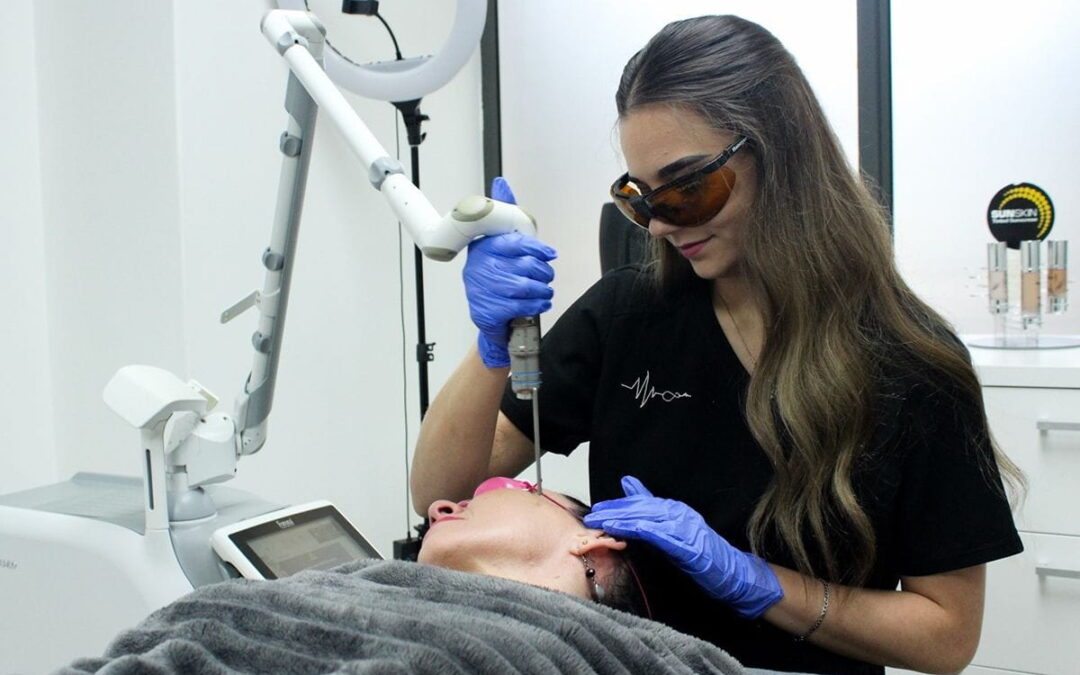
If you’re interested in laser treatments for face, you’ll likely want to factor in the recovery times associated with your procedure. While there isn’t a single set recovery period that applies to laser therapy, there are some general rules that will give you a fairly accurate idea.
NuSkinnovation is South Africa’s leading skincare clinic with years of experience and a track record of performing effective and safe laser treatments. This article won’t just guide you through these rules; it’ll also provide you with advice that helps to shorten recovery times, thus reducing discomfort while also improving the quality of the ultimate results of your treatment.
How Do Laser Treatments For Face Work?
Before we delve into any of the specifics surrounding recovery times associated with laser treatments for face, it is well worth setting out the basics of how this therapy works. It all sits on the shoulders of the laser system, a high-tech device capable of concentrating light into powerful and highly precise beams.
These beams are then used for a variety of purposes, most of them divided into two distinct categories: to destroy or to stimulate. The prior is easy to understand and fits nicely into our conception of what laser beams are capable of. In the context of a facial laser treatment, this would mean isolating and destroying the pigments in an unwanted dark blemish, clearing up the damaged capillaries of an area of skin experiencing vascular issues or burning off a wart.
The latter kind is slightly more complex but is used to achieve some of the therapy’s most iconic procedures. The laser beam is used to damage the target area only to the degree that it triggers the body’s own healing process, thereby flooding the area with fresh nutrients and collagen to give it a renewed look and feel.
What Are The Main Laser Types Used During Laser Treatments For Face?
We’ve already made it clear that there are two primary functions of a laser during facial treatments. However, there is another major distinction between treatments: ablative versus non-ablative. These two produce different results, but, quite importantly, rely on different laser types to work.
Ablative treatments involve running the laser across the skin’s surface, usually with quite a lot of power behind the beam. This causes more severe damage, producing more intense side effects. In return, it also yields more dramatic results. While the laser type varies, the most commonly used in these ablative treatments is the Er: YAG (or simply Er) laser. It’s shallow, penetrating and powerful, demanding a high energy cost and thus making it pricier than gentler alternatives. You’ll often see this laser used for intense skin resurfacing.
Non-ablative treatments, on the other hand, use the Nd: YAG (or simply Nd) laser. This laser doesn’t pack quite the same punch as the Er laser, but it can penetrate deeper into the skin and target tissue beneath the epidermis. This makes it ideal for addressing issues that run a bit deeper, such as vascular issues.
Alternatively, it can be used to complete skin resurfacing treatments by slowly delivering heat beneath the skin’s surface rather than from the surface. This allows you to achieve results nearing those of an ablative laser, but with less severe side effects.
What Are The Recovery Times Associated With Laser Treatments For Face
There are no set recovery times attached to any laser treatments for the face, as many individual variables in each scenario determine the ultimate duration. Yet, that doesn’t mean that we can’t still give you a pretty good general idea of what to expect.
If you’ve opted for the sheer power of ablative laser therapy, you’re going to be able to enjoy more dramatic results than if you had chosen a more mild-mannered sort of laser. However, the toll such a laser takes on your skin means recovery times for these treatments are far longer.
A fully ablative laser therapy can take anywhere between a week and a fortnight to start to fade, with significant improvements occurring between 3 and 4 weeks. A tinge of pinkness may even remain for a few months. You’ll start with acutely red and tender skin that peels, but this will slowly dissipate over time if you take good care of it.
If you instead chose to go for the non-ablative route, that means you’ve sacrificed dramatic results for a far more gentle recovery period. You’ll leave your session with what looks and feels like a mild sunburn, and within the next three days, you’ll find it to have completely cleared up on its own. There are compromising routes that offer middle-depth treatments. These offer both intermediate results and recovery times, demanding between 5 and 10 hours of downtime.
During your free consultation, your assigned aesthetician will help you decide on the best treatment plan going forward, taking into account your skin type, medical history, and skincare goals.

Why Recovery Times Are Some Of The Most Crucial
The recovery period that follows laser treatments for face certainly is important for achieving optimal results. During this stage, the target area may become inflamed and a little sore to the touch. It’ll be photosensitive and easily irritated by skincare products, cosmetics, heat, sweat and friction. Yet, under the surface, the full effects of your laser therapy sessions are coming into being.
If you’ve undergone a regeneration-stimulating therapy like a laser facelift, it is during this period that your body sends all the necessary nutrients to rebuild the damage caused by the laser. The more uninterrupted the recovery process, the lower the risk of complications and the more complete the rejuvenation.
Your therapy will be broken into multiple sessions, each working on the results of the last, but this cannot happen if you’re still suffering the lingering effects of your prior session. If, after each laser therapy session, you’ve allowed your skin to fully recover, the final results will be far more impressive than without.
During more destruction-focused treatments, this recovery process is still very important. It will be the time when your body takes the remains of whatever target tissue has been destroyed, be it natural pigment cells, artificial ink, or broken capillaries, and gets rid of it. During your recovery, you will visibly see the target blemish fade, and you will be ready for the next session. Your assigned aesthetician will offer guidance on post-treatment recovery.
How Do Recovery Times Compare To Alternate Methods?
Compared to lighter aesthetic procedures like chemical peels, microneedling and IPL (intense pulsed light), a non-ablative laser treatment has a roughly similar downtime of about 3 days. This means that if recovery time is the main deciding factor in selecting one form of therapy over another, laser therapy doesn’t really stand out on the lower levels.
That all changes as the intensity ramps up. Full ablative lasers are used for NuSkinnovation’s most intensive procedures, such as full laser facelifts. They might come at the cost of 2 to 3 weeks of downtime, but the effects are mild from that point onwards. Yet the results are used as a non-invasive alternative to surgical procedures.
Surgical aesthetic treatments vary in nature, but they are unanimously invasive, with a high degree of tissue trauma involved. It can take up to a month for clients to resume everyday activities, and even then, swelling will linger for many months afterwards. The risk for complications like infection or unwanted effects like scarring and bruising is also relatively high. Pain levels are also much higher compared to laser treatment recovery.
Reducing Recovery Times
You’re going to want to do everything you can to aid your body’s natural healing process following laser treatments for face. This is going to maximise the efficiency of your results, but it’s also going to reduce the total amount of discomfort that you have to go through. Fortunately, doing so is well within your power.
Your clinic will give you a specific aftercare regimen to follow between and after your laser therapy sessions. This will be focused on boosting recovery using a blended approach of damage reduction and nourishment.
Preventing unnecessary irritation and damage to the lasered area is crucial. If the already agitated skin takes on more stress, healing will be slower, complications may arise, and your results will be lacking. You’ll be asked to keep the area out of direct sunlight and to avoid any kind of artificial tanning too.
You should wear loose, comfortable clothing over the area that won’t cause friction against the skin. You need to steer clear of any harsh skincare products like retinols, astringents or exfoliants. Overly hot showers can irritate the lasered area, as can the heat and sweat of exercise.
On the nourishing side, you’ll be advised to add nutrient and mineral-rich foods to your diet like fruits and vegetables. You should stay well hydrated at all times. You can apply gentle creams or hydrating gels to the lasered area to soothe discomfort and encourage healing. Cold compresses are also welcome.
NuSkinnovation’s Preeminent Laser Treatments for the Face
If you’d like an experience of laser therapy typified by care, comfort and quality– you should visit a NuSkinnovation clinic. We have modern clinics across South Africa, and each of our facilities is in excellent condition. Not only are our machines top-of-the-line and well-maintained, but the staff who operate them are also trained professionals with a passion for their work.
We pride ourselves on delivering our clients the best possible results and the most comfortable means of achieving them. With the level of attention and care we put into our laser therapy procedures, not to mention the advancement of our technology, we are able to deliver powerful results with minimal impact on your skin. This directly contributes to shorter recovery times.
We are transparent about the downtimes and recovery times associated with all of our treatments, and, where possible, we offer our clients multiple routes to pursue the same treatment, each with varying recovery times. This gives you the ability to freely choose a treatment plan that aligns with both your desires and lifestyle.

Conclusion
In conclusion, laser treatment has no universal downtime or recovery time. Rather, recovery time varies depending on the treatment and the laser used. The quality of the clinic visited and the thoroughness of the client’s aftercare routine significantly influence the speed of recovery.
In general, ablative laser treatments performed on the skin’s surface take the longest to recover from, with up to 3 weeks of downtime and more than double that for a full recovery. Non-ablative treatments may not offer as dramatic a result as the prior option, but recovery times are much shorter, with only a few days of downtime. Mid-range options require roughly 10 days to 1 week of downtime and recovery.
At NuSkinnovation, we provide clients with only the highest-quality laser treatments for the face. With our help, recovery times are quick, and the process is safe and effective. Book your free consultation today!